Showing posts with label Crit List. Show all posts

Monday, August 29, 2011

A Wrong, Bad Book


(All quotes and images copyright 2001 Ken Ham, and are used for purposes of review. All art by Earle and Bonnie Snellenberger.)

Oh, yard sales, what wanton agents of fortune you are. I have been looking at this book for the last six months, trying to figure out how to write about it. The problem is that it's hilarious.

Ken Ham is a young Earth creationist. He argues that the Bible is literally true, and consistent with the fossil record, and that dinosaurs have lived alongside man until very recently.

Every single page presents one with a worldview so patently deranged that reading it is like being slapped with a rubber chicken over and over again. Nothing about it isn't funny.

Except that it's presented to children as fact, with the promise of Heaven and the threat of Hell held over them as a goad to belief.

I am an atheistic materialist. I find this is the only worldview that is both internally consistent and congruent with observed reality. I do not object specifically to the existence of religion, although I regard it as a sign that humans are not perfect thinking machines. I will say grace, I will attend church if invited, I will pray alongside the faithful when it is important to them. My feelings about religion are mixed. I state this up front so as to make my perspective clear.

Let me tell you something. If nothing else, living under the Bush administration taught me something about the banality of evil. This book features evil whose banality has gone baroque, and it announces itself as clearly as the hard buzz of a rattlesnake.

Young people often ask the question, "If there's so much evidence for the Flood all over the earth, and if it's so obvious God created, and the Bible is true, wouldn't the scientists surely believe these things?"

The answer is that scientists, like everyone else, are sinners. Because of this, they don't want to believe. It has nothing to do with the evidence. (Use of bold taken from text.)

If you are an adult, and you find, "Because I said so, and only bad people argue" convincing, you are an idiot. If you find the blanket condemnation of scientists as willfully-ignorant sinners acceptable, you are contemptible. But if you hear this when you're a kid, and your critical faculties haven't been developed, well.

In the future, the US will be able to look to Mr. Ham and say, "He helped keep our children away from science." I do not believe that will be regarded as a good thing. Mr. Ham is militating for a stupider nation.

I am not going to do a point-by-point refutation of Mr. Ham's position. I simply shrug, and say, "Geology, biology, paleontology, astronomy, chemistry, and physics all view the world the same way, and they work. You don't have the integrity to keep your own story straight, so not only is everything you say wrong, it isn't even wrong from a conceptually valid stance. Nothing you say is correct once you drift from the idea that people should be nice. Arguing with you is like braiding worms, and I will not do it."

I am going to engage in a bit of humor at the expense of Mr. Ham and the Snellenbergers. But as I do, please understand that I've imagined being a small child, and having the minister I have heard speaking with authority on the subject of sin and the fate of sinners come to me with this book.

I'm thinking about how much larger the minister is then I am. I imagine cologne, and warmth from his body as he sits next to me. This is a man of authority. He shows me a picture --

Take a close look at that gorilla. The single most important goal of this book? Get teeth wrong. Every damned time they show or mention a tooth? They get it wrong. Oh, and it's Eden so of course lemons are delicious. What kind of dummy are you, anyway?

-- and tells me that the only reason anyone would disbelieve it is that they are sinners and they choose not to believe.

What happens if I laugh? I don't know. But there is no way this situation could ever work to the benefit of the child.

I wanted to make this clear before I start with the haw-haw -- I am not belittling Mr. Ham when I mock his beliefs. Rather, I fear and despise the power he has over the lives of others.

He may be a good man. He may be, in the balance, a good father. But to present a child with this kind of cognitive dissonance is damaging, and worthy of strong rebuke, and I cannot find it in me to respond to this book and its mindset with anything but condemnation.

I understand that religion is the most important form of folk culture in the world, that the intellectual tradition springs from religion, that it is an important force for social organization. But it is the easiest way in the world for someone to simply claim a position of authority and begin exercising power and...

... remember what I said about the banality of evil?

Anyway.

Click on this image for madness. QED, motherfuckers.

What I love about this diagram? The implication that there is no problem here, see? They fit!

Now, the myth of the ark makes sense if you only know about a couple of dozen types of large animal, but by the time you take the world into account -- how many types of tapir are there, anyway? -- you have to start getting into some serious handwaving to get it to make sense, and our boy Ham here decides fuck it, pedal to the metal, we're including the entire fossil record as well. All of it.

Do you think he has a little cart in which to carry his balls, or do attendants bear them in a sling?

Is is just me, or does that kid have a holster? What kind of Bible-science bullets does it shoot? Or is it a zap gun? Probably a zap gun. This is all so exciting!

What's cute is the way Ham hates science so much he's going to reclaim silver jumpsuits for the faith. And the Biblical control panel is a concept resistant to speculation -- what happens when you turn the knobs? Maybe it adjusts Leviticus so you can stone people you don't like without having to eat kosher.

And let's take a moment to notice the semi-competent art. I bet the Snellenbergers have taken classes, maybe even have a degree or two between them. But the stiff, clumsy, vaguely ugly quality of the illustration is of a piece with the text.

When religious belief takes on a quality of grandeur, when it truly does exalt the human spirit, then it's hard for me not to get swept up in the moment. But this book shows a world without wonder -- flat words and images have condemned it to a sort of folding-chair spirituality, a cafeteria of the soul, a holy linoleum.

Okay, start at Babel, head North, and then turn left when you get to the white part.

I'll give them this much. I like this one. The idea of a polar pack-Pachycephalosaur is genuinely charming, in a crack-brained way.

I can't tell you how much pleasure and concern this terrible, terrible book has brought me. But interestingly, it has also led me to perform a dangerous act only to have my faith in mankind renewed.


These horses show up over and over again in the background of illustrations in this book, and they are never given a name. Actually, they aren't horses. The only type of living wild horse is Przewalski's horse, and these aren't those.

My current thought is that these are a Snellenberger's concept of a quagga. But the question of their identity was really bugging me. So I did the only Google search that I thought might give me some solid information. It was also the single riskiest search for images I've done since Harlequin ichthyosis.

"Wild ass images."

Of course my fear was getting into the eyebleach zone with scat porn at best and having my understanding of human sexuality expanded at worst. There are reasons the Internet age is also the age of hand sanitizers -- after the things we see, the entire world seems filthy.

But in this case?

Zebras, onagers -- wild asses. The ones I was looking for. The first screen I called up was entirely crazy little horsies of one kind or another.

I actually responded emotionally to the moment. Don't get me wrong, I don't feel crappy if I run across a picture of a cute butt on the net, but the idea that I could get clean results from that search seemed nothing short of miraculous. Perhaps I sensed the hand of God at work, a kinder God than one who'd put an old drunk on a boat with a bunch of fucking dinosaurs.

I didn't go to the second screen. Why tempt fate?

Tuesday, May 31, 2011

Lack of Enterprise


So today I let myself get sucked into this thing over on Amy's blog, and then I sent her my critical pieces on Star Wars and so on, and then this evening?

I got to finish the job. The missus and I just sat down to try watching Star Trek: The New Generation.

I like it when we have a TV show to watch. It's kind of a drag, but it's still time spent together. I'll watch some fairly dubious crap for the privilege of sharing a couch with her.

So we sat down to the first episode of Star Trek: The New Generation, and I didn't last a full ten minutes. Here's how it went, dialog slightly paraphrased:

Q: You are fighty guys and I do not like you. Get the fuck out of here.

Captain Picard: Aw, dude! No way!

Me: Jesus, this dialog is fucking awful.

The Missus: Shhh!

Q: Blah blah blah blah 'your fellow comrade' blah blah blah.

Me: Holy shit! Fellow comrade? They paid someone for both those words at the same time?

The Missus: Shhh!

Q: You know what your problem is? You fight on Christmas and you fight on your birthday and when you get up in the morning you pack a lunch so you can fight until dinner. That's what your problem is.

Captain Picard: No, we are not either fighty guys and that is not the problem at all. You know what the problem is? Space dildos. Space dildos like you.

Me: Bwahahahahahahah!

The Missus: Leave. Now.

So here you go. My critical position on Star Trek: The Next Generation.

I'm not allowed to watch it because I don't like it the right way.

Tuesday, May 10, 2011

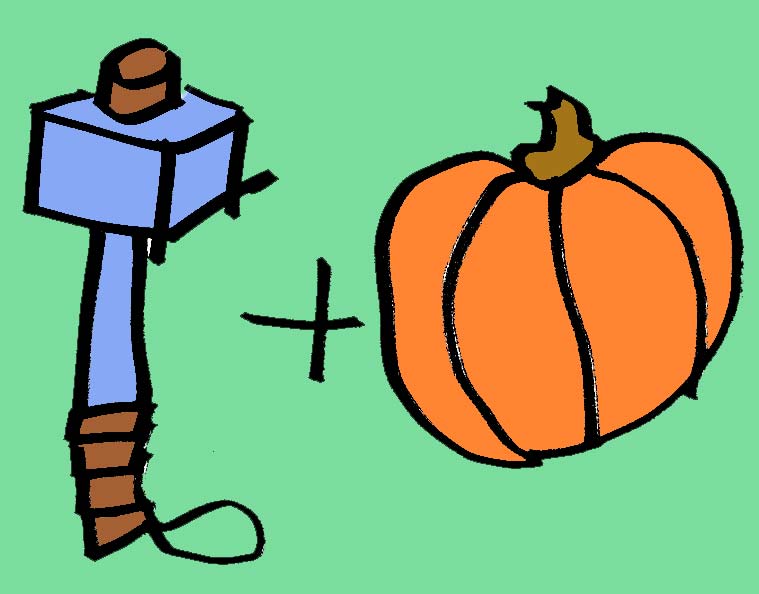
Hela Thor or Waiting For The Great Pumpkin


So the old man has a taste for movies with swordplay and gleaming armor and so on -- we wind up seeing things like Beowulf and 300 and Clash of the Titans, so it's just a matter of time before I wind up at a Tom of Finland retrospective with my father. That will not be a proud day.

Anyway.

He took my sister, my nieces, and I to see Thor, and we all loved it. We sat down, tipped our heads back, and laughed like a pack of fucking hyenas. I haven't laughed out loud at a non-comedy in some time. It's a good thing the people who made the movie weren't there. They would have hated us.

It's hard to say exactly what it was that infused this meatheaded pec-fest with the comic spirit, but it seems to arise from the details. They went to the trouble to really pay attention to the little things, and get every single possible detail wrong. For instance, the Celtic knotwork on Mjolnir, or Thor's... can it even be called an accent?

I once knew a woman for two years before I worked up the nerve to ask about her accent. It turns out she was Scottish, but had spent a long time in Denmark. Thor's accent was kind of like that, but more Dutch, somehow. In the liquor store on Dwight, they have Grape flavored blunts, but they also have Purple flavored blunts. Thor's accent is an accent the way Purple is a flavor. It's confusing in a way that makes you want to accuse someone of racism, but you don't know who or why.

That's why it's a good thing that Asian-American Viking and African-American Viking were around, because if it weren't for them? Asgard would have seemed kind of Eurotrashy.

Speaking of which, the plodding ugliness of the design was fucking relentless. Hope you like masses of gold. They got plenty. Pretty much everything's gold, except for Bifrost, the rainbow bridge, which emanated distinct Pottery Barn vibes, despite the steampunk raygun grafted to its front end.

(I'm not clear on how that worked. People got shot through the raygun or some damned thing. It was too stupid to bother understanding.)

Early in the movie, they had a scene where Thor pitches a hissy-fit and tips over some tables at a banquet, and all these pumpkins roll off the tables and down the golden steps. Spoiler Alert! You know how deluxe things are in Asgard? They got orange pumpkins -- and white ones too!

"Oh, Mighty Thor -- y'all eat those things, or are they just there for decoration?"

I figured, eat them for sure. They're gods. They could chew up pumpkins easy. Hell, they could probably eat plywood if they wanted. So basically I spent the whole movie waiting for the scene where Asian-American Viking turns to African-American Viking and asks, "Could you pass me a pumpkin?" and African-American Viking says, "Sure, you want orange or white?"

Ka-runch. Nonch. Nonchnonchnonch. That's some good pumpkin.

Now if I were to offer a genuine critique, I'd say something about how Thor's story here is based on a twenty-first century revamp of the character that eliminated the dramatic elements connecting him to the real world, and how the lack of grounding makes it impossible...

Oh, come on. If this were a real critique, I'd have brought up Kenneth Branagh's earlier films, and then staggered around the room, colliding off the furniture while clutching my scalp and screaming, "What the fuck? What the fuck?"

And that gives a bad impression.

Look, it's a crappy movie. When you spend this much money on a film and you can't even make it fucking look pretty, it's a sad state of affairs, and when a genuine talent is presiding over the shambles, it's sad enough to start seeming funny.

And then I remember the pumpkins, and I have to admit, it was a terrible movie and I loved it.

Wednesday, November 10, 2010

Magical Blood Math


(Art scanned from the rule book for purposes of review/slander. I couldn't find any credits for a specific artist. Sorry, artist, I would name you if I could.)

So I clapped eyes on this, and thought, "Holy shit, this is an actual revolutionary moment in popular culture. I've never seen anything like this before -- an attractive older Latina, a little on the stocky side, none of that brass bikini crap. This is something that would make someone none-white feel a little more at home, that won't make a woman feel shitty automatically. It's pop-slop crap, but the health of the image is more than compensatory. This is motherfucking fantastic!"


Then I noticed she was a Dwarf. (Not a little person; a Dwarf. Sorry, it's not my fucking terminology.) What the fuck? That ruins everything!

Or does it? Maybe it's still cool. No it isn't. This is...

My thoughts felt like angry bees for a few moments, and then I settled down and asked the real question, one which brings the current vernacular term 'shorty' to mind.

If MILFs are Dwarfs, then are standard hot chicks hobbits?


No, this is a motherfucking hobbit. The four-year old listening to The Hobbit being read aloud has just been left bleeding in the intersection, thank you very much, but I like this a lot.

Because it is a triumph for a commercial artist working with the corporate machine, man.

Here's what happened.

Art Director: Okay, so Bilbo Baggins was a burglar, okay? And he had a sword called Sting?

Artist: Here. Sting's a cat burglar with a sword. Give me my fucking check.

And that fucking candyass gave him the fucking check. Go, team.

So I mentioned that I've been spending more time with my nieces, who for blogging purposes may be known as Poppy and Spike. Poppy had a birthday recently, prior to which my sister and I had the following exchange.

Oaf: I've been trying to think of things to do with them. An evil corner of my soul thinks I could drag them down to perdition and get them into Dungeons and Dragons.

The Sister: You've got to do it. You've got to geek them.

So I picked up a copy of the Basic Dungeons and Dragons boxed game.

I have a gaming history. I got into it back in the mid/late seventies and played until I left Richmond at eighteen. When I started playing, there were no high-impact dice. Blue-cover basic was my start. Did a lot of stuff with a mix of AD&D and Arduin, which is the role-playing equivalent of making fire with sticks. I wrote a bunch of games myself, even played a few of 'em. These days I'm a distant spectator, but I still follow things.

So I had a few hopes. I'd always figured role-playing had a real industry in it and sure enough, it's here. I'm used to RPGs being strictly amateur night. I knew what was coming, but it turns out I wasn't ready for it.

Corporate fantasy.

I have seen a lot of shit fantasy on the shelves over the last forty-six years, and I believe I have located an asshole. This is fantasy systematically stripped of anything resembling individual vision, and reading it is like eating gravel that smells bad. It is Tolkien heard the sixth time round the ring in a game of Chinese whispers.

Worse. This isn't shit fantasy. This is a set of instructions for creating shit fantasy. There are some wonderful ideas in here -- doing character creation as a solo adventure that produces a character the player will enjoy playing is just brilliant. Shame the type is so small, the rules so needlessly complex --

There we go. That's part of it. When I said this was stripped of anything resembling individual vision, I overspoke. There is a love of rules and math here that speaks clearly. This is the product of people who, in playing Pac-Man, would rather not use a computer to run the algorithms. They'd rather do it themselves.

Because of this love, they did not want to strip the game down to the point where it would actually be accessible to someone who had never gamed before. There's another aspect, too. If someone can jump through the hoops this rule set presents, they are likely to be the kind of person who would like to work with even more rules. This is an industry run on rule consumption, thousands upon thousands of pages of rules. Here's how that works out in real life.

When Poppy opened the box she was thrilled with the maps and the counters, and devoted a lot of speculation to what the characters were like and who she'd like to be in the game.

Then she cracked a rulebook, and started reading. A few minutes later, she came over to me, a look of irritated concern on her face. "Do these people have any idea at all what kids like?"

Case closed.

Friday, October 8, 2010

Helping Anonymous

Yes, I know. We're acting like a couple of children. That's just how it is with hyperintellectuals and whatever the hell he is.

Anonymous said...

My google alert caught your response & i was atingle to discover a new blog. If i'd known "That really stupid essay in the Times" was not in quotes for irony, i wouldn't have been so underwhelmed by your boring word choice. Try some subtle gradients in your prose !It sound's like Waynes World, which was satirical mockery of dude jargon in the last century. No idea what you were trying to say about anything but your own choice(?) or default (?) lack of skillz with words. And yes, i used skillz because it's from back in the day when middle school kids called called everything fucking nuts &retarded, dude. ;)
Use a thesaurus! Edit!
Bonaboba


Look. Anonymous. When you criticize someone's prose, it's a good idea to either qualify your criticism with a statement like, "I not smart but know words stink," or "Since that's how I'm handling it, my writing is going to be fucking awful," so as to draw attention away from any of your own shortcomings in that area.

Another way of handling that situation is to show some minimal command over the English language. On consideration, that might be best. Let's see how your comment would read if written in something closer to standard English, just for chuckles. Proper nouns, punctuation, all those petty things with which we low-grade prose stylists are so infatuated.

Anonymous said...

My Google alert caught your response and I was atingle to discover a new blog. If I'd known the post's title, That Really Stupid Essay in the Times, was not in quotes for purposes of irony, I wouldn't have been so underwhelmed by your boring word choice.

Whew. The obvious fixes are not going to be enough to salvage this one. Now, I know this isn't a compliment. So as we go, if I find myself feeling as though I've been praised, I'll know I'm in error.
"If I'd known the post's title was intended seriously --"

Really? That's what that said? Interesting.

"If I'd known the post's title was intended seriously, I wouldn't have been so underwhelmed by your boring word choice."

I fail to get the connection here, but this does look a lot like a comprehensible sentence so we'll let it stand. I'm nurturing a fantasy of Anonymous hoping for a brilliant excoriation of that squealing, vapor-filled article fit to stand with the works of Swift and Mencken, and writhing in an agony of disappointment on finding, instead, the word 'dude.' Alas, this sentence is our only hope of knowing more.

"Try some subtle gradients in your prose! It sounds like the dialog in Wayne's World, which was a satirical mockery of dude jargon in the last century."

I think the exclamation point is a bad idea. It pokes a hole in what's left of your gravitas after the capitalization and spacing errors had their way with it. But it's your anonymous comment, Anonymous.
I have to admit, you pricked me with this one, you scoundrel. I must admit, I'd thought a piece of writing that runs from, "Are those guys huffing thinner?" to, "Anyone with the most infinitisimal grain of sense or experience knows that suffering is an absolutely necessary and unavoidable part of life, and that exaggerated attempts to avoid it cause grotesqueries that bring suffering of themselves," might have some subtle gradients to it, but then, we're always the worst judges of our own work, aren't we? Thank you, Anonymous, for calling this weakness to my attention.

No idea what you were trying to say about anything but your own choice(?) or default (?) lack of skillz with words.

Anonymous, at this juncture I must act with boldness, and I crave your pardon if I misread your intentions. However, this sentence is a crafty foe, and resists all conventional analysis. I must allow myself the luxury of intuition. And out of sheer love of invective, I will endeavor to bring your insult out of the murky depths of awkward syntax and up into the light of day.
I have no idea what you're saying here, due to your extremely poor writing ability. I would suggest that you polish your 'skillz.'

Ho! Ho! Anonymous, I just slapped my thigh in mirth. That's the stuff, is it not? Do you notice how it's not necessary to explain that your use of the word 'skillz' is sarcastic when the rest of your missive is written in standard English? I may not be able to write the way you think you can, but I do know a little bit about humor. Word to the wise. Make sure your jokes are funnier than you are.
Now that doesn't mean we should throw the baby out with the bathwater. How about...
You should know, only middle-schoolers use terms like, 'fucking nuts,' and, 'retarded.' 'Dude.' ;)

You have no idea what it cost me in terms of emotional health to leave that emoticon in place. But for you, Anonymous? No sacrifice is too great.

Use a thesaurus! Edit!
Bonaboba

Okay, I'll leave those there. In a way, they're the best part.

First off, 'use a thesaurus' is terrible, terrible advice to someone who needs access to a more varied and flexible vocabulary. Learn to use words in speech before you put them into your prose. When you fish in a thesaurus for interesting words while you're composing, you wind up with the kind of verbal slop McMahan produced in The Meat Eaters.

And that last word. The cherry on top. Literally the punchline. Edit! At the end of that email, the command, Edit! Really, Anonymous. Now you're just being silly. If your comment is the result of someone scrupulously editing with a thesaurus at their elbow? Do I need to continue?

So let's see how it turned out. From...

Anonymous said...

My google alert caught your response & i was atingle to discover a new blog. If i'd known "That really stupid essay in the Times" was not in quotes for irony, i wouldn't have been so underwhelmed by your boring word choice. Try some subtle gradients in your prose !It sound's like Waynes World, which was satirical mockery of dude jargon in the last century. No idea what you were trying to say about anything but your own choice(?) or default (?) lack of skillz with words. And yes, i used skillz because it's from back in the day when middle school kids called called everything fucking nuts &retarded, dude. ;)
Use a thesaurus! Edit!
Bonaboba

... to...

Anonymous says...

My Google alert caught your response and I was atingle to discover a new blog. If I'd known the post's title was intended seriously, I wouldn't have been so underwhelmed by your boring word choice.

Try some subtle gradients in your prose! It sounds like the dialog in Wayne's World, which was a satirical mockery of dude jargon in the last century. I have no idea what you're saying here, due to your extremely poor writing ability. I would suggest that you polish your 'skillz.'

You should know, only middle-schoolers use terms like, 'fucking nuts,' and, 'retarded.' 'Dude.' ;)

Use a thesaurus! Edit!

Bonaboba

Bonaboba... Oh, you tease. You may be Bonaboba to your mother, but you'll always be Anonymous to me. And Anonymous, just between the two of us? When we're together, I imagine -- and how sweet it is, to imagine this -- that you are Jeff McNamara. Ours is a strange love, is it not?

That Really Stupid Essay in the Times

Further refinements and a touch of color. I don't like the black corners; only the streetlamp and lines should be black.

Note the subtly varied color -- I've found that by using layers of transparent gradients, I can get a much more interesting, much less 'dead' result than a straight-up from the box gradient. Bringing life to digital art is the real trick.

I thought I was going to be able to avoid writing about this, but I've been obsessing on it to the point where I've been losing sleep. This is retarded, but this is what it's like to be crazy. How crazy?

Crazy enough to care about the state of intellectual discourse in the US. I mean, you've seen crazy from me before, but not on that scale.

Here's the article I'm addressing.


If you ain't up for it, dude is saying hey, shouldn't we be thinking about how we can eliminate meat-eating? As a behavior? In animals everywhere? Like, just get rid of the carnivores because they're real mean.

I shit thee not.

I tried to imagine that this is some kind of put-on but if it is, this guy puts Andy Kaufman in the fucking shade. I really think he means it. Red wine? Pot? Both of the above, maybe a little medication mixed in? Because these just do not seem like the thoughts of a sober man.

Let's get this straight. I don't think Jeff McMahan is a bad person. And for all I know he's done work that would blow me out of the fucking water. But as I write this, I will abuse him as a fool over and over and over again because this essay is stupid as shit -- which is bad -- and it was published under the rubric of the New York Times. This is fucking nuts. Isn't that the paper of record? Are those guys huffing thinner? What the hell is going on?

Okay. I don't want to spend time on this. I want to spit my bile and move on. Since that's how I'm handling it, my writing is going to be fucking awful, so I won't make a big deal out of how...

Rob once sent out a rejection letter where he accused the person's manuscript of having been 'rat-fucked by academia.' If you're wondering what that means, go read the essay. 'Too stuffed to jump' is another phrase that comes to mind.

Anyway. On to the meat. First off, the core of his position is this statement.

"It is relatively uncontroversial that suffering is intrinsically bad for those who experience it, even if occasionally it is also instrumentally good for them, as when it has the purifying, redemptive effects that Dostoyevsky’s characters so often crave."

I'm sorry, but that's a load of stupid you need a wheelbarrow to move. It is not at all uncontroversial; rather, it is the exact opposite of the truth. Anyone with the most infinitisimal grain of sense or experience knows that suffering is an absolutely necessary and unavoidable part of life, and that exaggerated attempts to avoid it cause grotesqueries that bring suffering of themselves. Without the experience of suffering it is impossible to truly understand the suffering of others.

Life exists in a dynamic situation of contending forces. Pleasure is the way our organismic selves guide us toward things that have proven beneficial to the meta-organism in the past, while suffering guides us away from things that have proven harmful. To the species, not the individual, please note. Suffering is not a source of harm; it is a warning that harm is being done. To struggle against the real sources of suffering is a noble thing. To attempt to eliminate suffering itself is like tearing out your goddamned smoke alarms. Jackass.

Are you familiar with the fate of those who do not feel pain? They, and those around them, must be constantly inspecting their bodies for unnoticed injuries. They frequently die young.

Get me?

And starting off with that muttonheaded Schopenhauer quote -- “one simple test of the claim that the pleasure in the world outweighs the pain…is to compare the feelings of an animal that is devouring another with those of the animal being devoured.”

What kind of idiot actually thinks that is a reasonable picture of life? I rather doubt it was one who had any experience of animals and how they live. Note the pleasure/pain dynamic above. It is tuned, so that a typical animal under typical conditions will of course experience more pleasure than suffering because that is how the relative functions of pleasure and suffering balance. Mild pleasure lets you know you're doing okay, suffering tends to indicate special circumstances. An organism that suffers more than it experiences pleasure is not a typical organism -- it is unfortunate.

And as for the specifics of one animal eating another. This is squeamishness, plain and simple. Would you rather be eaten by a shark or die of AIDS? Neither will be pleasant; the first will be much faster.

It also may not be as bad as you'd think. When David Livingston was attacked by a lion, he reported a dreamy sense of disconnection; anyone who's handled animals injured by cats has seen something of this.

Listen, McMahan? Most animals don't die of predation. Most animals die worse deaths. Most small animals die of pneumonia. Think of all the tiny mice and birds laying on their sides and quivering as they drown in their own snot and then tell me how cruel predators are.

Goddamnit.

Next up is this little doozy. In reference to the notion that it may be possible to some day engineer carnivorous behavior out of the ecosystem, he says, "Rather than continuing to collide with the natural world with reckless indifference, we should prepare ourselves now to be able to act wisely and deliberately when the range of our choices eventually expands."

So let me get this straight.

If we ever get magical superpowers, we should already have our wishes lined up. Is that what he means?

The idea that we should invest thoughts in hypothetical situations like this does have a place. It is in fiction. And if McMahan had plotted this out with the intellectual rigor used in the best science fiction, he may have come up with something of interest to say.

But that would mean speaking from a position of knowledge. He would have to say something meaningful about how predation operates in the ecosystem, how we'd manage birth control for moths and so on. He would have to really think, not engage in the outgassing of an intellectual colon.

Doing this kind of half-baked wambling about does not have anything to do with real thought. This piece consists of words and half-understood emotional impulses chasing one another around a cranium that is either permanently fuzzy or temporarily pixilated.

To prime oneself for possible action based on guesses made from a position of profound ignorance is a terrible, terrible idea. Jesus, McMahan! What the hell!

Okay, I'm sorry. That was uncalled for. But it really, really pisses me off that this kind of vague dopey slop -- and sorry, McMahan, I'm sure you're a nice guy and this isn't representative of your work, but this honestly does read like the transcribed ramblings of an over-educated stoner -- is being placed before the public eye and given the gloss of credibility that comes with The New York Times. This is the pathetic state of discourse. And here I sit, stewing bitterly in petulant insignificance. Unread save for the true elite.

(If for incomprehensible reasons McMahan is reading this, that was for you -- I am a spiteful nobody. Go ahead and dismiss my ravings. Plus, really, I'm irked because you want to get rid of all my favorite animals.)

Listen up, US of A. This is a warning. I'm watching you.

Think better.

Or else. I mean it.

Tuesday, May 19, 2009

Crit List Stardate 2009: It's Not 'To Boldly Go,' It's 'To Go Boldly,' You Semi-Literate Baboon

Every time I post without a picture of some kind my soul dies a little; I have no other excuse than compulsion.


I started writing this as a reply to comments from Rob, Peter, and Craig on my last post when I realized that what I was writing should be a post in itself. I do go on, do I not?

I have a confession to make. I never really enjoyed Star Trek until recently.

As a kid I watched reruns of Star Trek every weeknight and was vocal in my support of the show. But in my heart of hearts I found it insanely boring.

This tradition continued with The Next Generation. I watched the very first episode (as I recall it was titled Planet Of The Naked White People), and at one point in the show I found myself confronted with a conundrum.

There was one scene where the lead characters were walking through a vast warehouse-like space filled with gauze-clad blond couples humping and it was boooooooring.

(As an aside, when the missus and I were going through our rough years from time to time she'd tell me I needed to be more like Captain Picard. "I'm trying," I'd say. "I'm getting more emotionally distant and I'm balding as fast as I can. What the hell more do you want?")

That was when I began to formulate the Bikini Paradox -- there is nothing in the world more interesting than an attractive female body yet mere skin is not enough to redeem crappy entertainment. Even Raquel Welch needed dinosaurs to maintain interest through a whole movie.

Anyway, in the last couple of years I've seen a fistful of original Trek episodes and found myself loving them. First off, there's the other side of the Bikini Paradox -- when something is entertaining, a certain amount of cute girl (or whatever your preference is) really adds something.

The women used for display purposes back in the Trek days were of distinctly higher quality than the current crop, whose devotion to unfortunate diet and exercise programs, cosmetic surgery, and Photoshop qualifies them as cyborgs. Take a look at the Olsen twins and then let me commend to you the thighs of Yoeman Rand. Case fucking closed.

But that's just part of it. I also adore the crappy drywall on the Enterprise. I do (or, rather, did) better drywall than that. The Enterprise is a dump and I love it. The idea that the Federation is underfunded and shoddy really has some appeal for me.

Then there's the rocks. The same damned rocks in scene after scene after scene, all lit with weird gels. Old school Star Trek is all about the tacky.

And the best part of all is William Shatner's gut. When you start tracking it, it becomes a source of genuine fascination. Kirk makes a dramatic speech -- low tide. He thinks you're not watching -- high tide. I find myself vigilantly waiting for the moment of relaxation. Suckitinsuckitinsuckitin -- aaaaaaahhh. The relief.

There were a lot of things about the Trek movie that bugged me from a critical standpoint. It was one of those movies that's basically one long action scene with no room for the characters to breathe. The plot was entirely dependant on coincidence. (A good craftsman allows themselves one coincidence -- one 'gimme' -- per story, maximum.) The science was crap, of course -- but it was interesting to see them alternate scenes where there is no sound in a vacuum with scenes where there is sound in a vacuum. (Those simpering halfwits do dearly love to stay on the left side of the bell curve, do they not? I bet the Silent Space scenes were concieved of as salutes to Firefly rather than physics.)

The creators never allowed any touch of reality to stifle anything that looked cool, a modality that always leaves me emotionally disconnected. If you aren't going to try to be believable, why should I believe in you?

(See Peter Jackson's King Kong, a movie that kept popping into my mind while watching Trek.)

Ol' Kirk spend a fuck of a lot of time dangling over precipices, none of which existed for any other reason than Kirk-dangling. Star Trek was all flash and no guts.

But it was fun to look at and the idiot breakneck pace kept it from getting boring, as did the return of the Starfleet miniskirt. (I also liked the nod to Kirk's bad case of chartruese fever.) And there was a point of redemption, of true contact with the tacky, low-budget, half-assed Star Trek that I have learned to like, if not love.

Where once we had William Shatner's gut --

(Have I ever told you my theory of Actor Continuity? That every character an actor portrays is the same character? An example. Jeff Bridge's character in The Big Lebowski is addled and doofy as a post-traumatic stress reaction to what happened to him in Tron. Likewise, when James T. Kirk grows up, he turns into Denny Crane. The man was destined to be a sweaty drunken obese pervert -- may I be as lucky.)

-- where once we had Shatner's gut, now we have Leonard Nimoy's dentures. Interstellar travel they've got, teleportion they've got, time travel and interspecies sex they've got, but poor old Spock is still slurring because his Polydent isn't up to the task of keeping his choppers in place.

And they still don't have fucking seatbelts.

Mektoub.

Saturday, April 11, 2009

Crit List 8: The Parade Of Sleaze Continues -- Alligator Alley and Dr. Adder

Come on, just look at that cover.

Alligator Alley

Well, I may not know for sure, but I get the impression that this is a collaboration between underground cartoonist Tim Ferret and underappreciated novelist K.W. Jeter. The book itself -- a particularly delicious example of the Book-As-Object -- claims that it's written by the two main characters.

Allow me to quote:

In a nutshell, it was over before it began. The first guy ate a long, rectangular trash can and promptly laid down to 'sleep.' The second, apparently experiencing some last minute trepidation, tried to pull away from me. "What's your hurry, pal?" I locked my hand around his throat and lifted him up into my face, the red coals of my eye holes reflecting back to me from within his own. He went for his piece, but I folded his arm back around him until it snapped and, much to my amazement, came off! Upon finding himself 'disarmed,' he obliged me by proceeding to eat the sink and several other restroom accessories. I forget which ones exactly, as I was checking his wallet at the time.

If you can say no to that I will happily beat you to death with a nail-studded two-by-four... Nah, not really. The two-by-four fits uncomfortably in the hand. You know what I really like? A kid-sized baseball bat, one of those little ones. Enough mass to give a substantial wallop but not so much as to slow a guy down.

Maybe weight the end with a little lead -- drill a hole in the tip and fill it with melted sinkers. Sweet.

Anyway, the book is pretty fucked up; no real story and a bit of tedium here and there. I do not care. I love this book. If you think of H.S.T. as the conduit through which the spirit of Gonzo flowed, this work is the one piece of science fiction moved by that same great spirit.

Plus, there are great illustrations. Like I said, book as object.

Mektoub.

Dr. Adder

Those in the know tend to credit John Shirley's City Come A Walkin' as the Patient Zero of cyberpunk. For me, it's this book, which was finished in 1972. If Shirley is the Ramones, this is the Velvet Underground. Not exactly the thang but it has all the markings -- and it has the specific vibe of the sixties turning into the seventies, of moral decay really setting in. Of the Hustler/Penthouse era that made my flesh crawl when I was a child. The pervasive feel of urban scum in this one is just awesome.

You've got high-tech lowlifes, perverse sex (genetically manipulated intelligent giant chicken fucking is how the book starts out), lethal prosthetics, and Philip K. Dick references.

It's a SF novel written, to a great extent, about decadent Seventies pornography and the spiritual toll it exacted. Hey, folks, we live in an even more porn-saturated culture now. The plot of this novel centers on the personal and political conflict between a porno-doc who performs elective surgery on women to turn them into uber-whores and the degraded TV preacher that he done wrong. I read this in the Reagan years and Jeter was right! (rings bell, waves placard) Jeter was right!

The edition I have is the Bluejay Books version, with excellent interior illustrations by Matt (Was I just talking about the gonzo?) Howarth. If I included comics in this list, his Those Annoying Post Bros. would be near the top.

Next:
CAPTAIN BLOOD
THE OWL

Friday, April 10, 2009

Crit List 7: Let The Parade Of Sleaze Begin -- The Fungus and Fear And Loathing In Las Vegas

Turn your head. Now cough.

Fuck it. I have three short stories to revise, an issue of Swill to start assembling, the next print to make and the one after that and so on, the novel is pleading with me, begging with me...

Fuck it. Internets, I have been away for too long. And it's been too damned long since I just had a little lonesome geek fun.

It's time for the sleaze. Sometimes I want nothing more than a simple, wholesome diet of sex, drugs, and violence -- or, to be depressingly honest and list them in the order of significance in my resume, violence, drugs, and sex a distant third...

Weep for me. But sex moves way up on the list if you include frustration and obsession. I am, after all, a twenty-year veteran of a committed monogamous relationship.

Anyway, let's get down to it. No comics, no movies, and yeah, I've got literary pretensions but sometimes I need to read something fucking sleazy. The following volumes should prove adequately repulsive, and the keen-eyed reader shall find keys to other realms of sleazery.

These books are fucking great. The standard by which all of belles-lettres are to be judged. And if you disagree?

Say it to my face, motherfucker. Go ahead. East Bay, motherfucker.

THE FUNGUS
also published as DEATH SPORE

Film critic John Brosnan wrote a number of horror novels, both by himself and in collaboration with friends of his. These were done under the pen names Sidney Ian Childers = sick and Harry Adams Knight = hack.

These are R-rated B-movies on the page. The clever kind with a wicked subtext -- think Roger Corman or Larry Cohen. Brosnan's great literary innovation lies in his treatment of victims. I mean, if you've got a monster you need some fucking victims. Brosnan had a real knack for developing characters you care about in a couple of pages -- and then he'd kill them in fine gross-out style. The videonasty pattern of cutting from the main story to a victim and then back to the main story is a very useful narrative pattern.

Victim-oriented high points in The Fungus include an obese bartender who suffers explosive fermentation from the yeast in his belly and a lesbian couple, one of whom intentionally infects the other with thrush. They come across as real people, you like them or at least sympathize with them, and they die horribly.

When I say these books are movies on the page, it's not just story structure that I'm talking about. Brosnan has a vivid visual imagination; I see everything in his books. Don't quite get the voiced but I watch his books.

One of the minor pleasures of these works is the sense that Brosnan (or one of his collaborators) spent some time in the library looking things up. The Fungus is willing to toss the occasional scientific name at you. I dig that shit.

Slimer is weak; Tendrils is weak. Every other SIC (Worm) and HAK (Carnosaur, Bedlam) book is great. May I make a particular note of Carnosaur? It came out before Jurassic Park, had pretty much the same idea, was a more entertaining read, and had better science. Funny, that...

A quick aside concerning Tendrils. I picked up a copy at a library sale and was thrilled. Unfortunately, it had a misprint that ran through the whole book and rendered it unreadable. So I had to order another copy from a bookstore in the UK.

Thing is, the two editions have far and away the best Monster As Penis imagery ever.

I am convinced that this painting originally had the penis monster going right into her mouth...
For christ's sake, who the fuck did they think they were kidding with this?


For a while this guy and Aleister Crowley were my main role models...

Fear And Loathing In Las Vegas

When I was a teenager my buddy Mac Melendez turned me onto this one. I'd previously dipped into The Great Shark Hunt without much real interest; this grabbed me like no other book had up to that point. I read it every day for months -- the book itself got me high a couple of years before I got into drugs.

I read it as fantasy adventure. And I knew -- knew! -- that this was what fun was all about. Recently a friend asked me what drugs I've done...

"Well, I've never done heroin. Never had enough opium to actually get off on it. And there's a whole bunch of psychedelics that came out in the nineties that I never did. Never had an adequate dose of Ecstasy. Came close to ether once. And I haven't had access to most pharmaceutical stuff."

That took less time than it would have taken to talk about what I have done. Fuck it; I'm a Californian who grew up in the Seventies. What the fuck did you expect? Drugs were our rite of passage.

Anyway. As a writer I look at two things -- the headlong flow of action and the use of vivid specific detail. Not to mention the drug-addled logic -- the protagonist sees a giant flying electric snake outside his hotel window. His reaction? "I want to study its habits." Fucking brilliant. And this is all highlit by the casual quality of his prose -- you can tell this was coming off the top of his head.

Got to say, though, I think Thompson would have been a lot better off if he'd copped to the fact that drug abuse was bad for him. So far as I can tell the great tragedy in his creative life was that he never wrote a great novel and I think the drugs had a lot to do with that. You need clarity and focus to work in long forms and being able to toss short pieces out without effort does not help you in that arena -- not that I'm pitching too heavily for sobriety. A lot of people do their best work during their times of maximum intake. But those folks tend towards the mayfly side of the longevity spectrum...

... and not all of their work is what it could have been.

And his stupid tough-guy pose was more than likely the cause of his pussying out at the end. That's what did it to fucking Hemingway as well... There's nothing more vulnerable than someone who can't cop to their vulnerability. Why do you think women live longer than men?

Still, who can read Fear And Loathing and not want to tour Las Vegas with an extensive pharmacopoeia and little interest in self-preservation? Not me, that's for darn sure.

Next:
ALLIGATOR ALLEY
DR. ADDER

Wednesday, March 4, 2009

Crit List 6: MonsterQuest Part Two -- Of Course They Get On My Nerves...


Again, not the most polished work I've done -- but the art isn't the goal. The point of this is to get myself in the habit of sketching daily. Once the habit is in place I'll start worrying about quality.

Before I go much further with this I should make one thing clear -- my idea of evidence has very little to do with eyewitnesses. The human eye and brain are not a recording system.

People are terrible witnesses. People frequently have experiences that did not actually happen. That doesn't mean they're crazy or lying -- it means they're human. Gaps and fill-ins are part of our sensorium. Add that to the fact that there are crazy people and liars in the world and you've got a situation where it's going to take a lot more than a witness to convince me of the absolute existence of anything.

I'm going to require verified physical evidence to believe in anything.

So here's what I don't like about MonsterQuest.

The problem is that the show plays to the gullibility of the public. For every moment when they show an expert debunking a piece of evidence, they balance it with a voiceover commentary saying, "While this may be unlikely, there is still a possibility that an unspeakable horror may be lurking in the depths, waiting for your children."

In an absolute sense, yeah, absence of evidence is not evidence of absence -- but to keep hammering at possibilities when probabilities have been fairly clearly demonstrated is intellectual dishonesty.

Yes, these things may not be absolutely impossible in many cases -- but most of the time they are so unlikely that you may as well make similar claims about Pikachu and the Tooth Fairy. 'Just barely possible,' isn't 'maybe,' it's 'almost certainly bullshit.' This is a very important distinction that a lot of people aren't good at making.

I know this is a television program and I know that it is entertainment. That doesn't absolve the makers of their responsibility for the show's effects on society. And right now our society is hurting for rigorous thought.

For instance, take the giant trout report I mentioned in the first part of this piece. They had one report from one person of something very much out of the ordinary and they just put the pedal to the metal and went for the investigation without once indicating that the guy in question was in all likelihood crazy or a liar -- and when they found no evidence whatsoever to support his claims they simply shrugged and said, "The mysterious depths."

Now maybe the other reports ended up on the cutting room floor. Maybe the statement that, "In the end, there is no reason to believe a goddamned thing this daffy old coot says," was likewise excised.

But in that case, the editors are responsible.

The show presents almost every single claim on exactly the same level. And in most cases -- the episode dealing with the monsters generated by bird and insect flight as viewed through cameras being a rare exception -- that level is, "Okay, regardless of the evidence this could be true. Sure, the evidence makes it seem unlikely -- but it could be true! It could! Maybe."

Look. This is dishonest. It preys on the typical person's lack of practice and training in critical thought. When I mentioned in the first part the pleasure of the feeling that kind of thinking engenders, it's coming from someone who's worked hard to look at exactly these kinds of phenomena from a critical stance, who has made a point of researching and double-checking, and thinking really, really hard.

Someone who doesn't have that background isn't necessarily going to recognize the fact that they're being fed bullshit.

I mentioned that there seems to be missing information in some of these episodes; in some cases, the missing information is of real interest. The episode dealing with giant squid in the Sea of Cortez featured an early interview with a scientist who claimed a theoretical basis for believing in such squid.

His on-camera statement was so vague and meaningless that I dismissed it out of hand. It was a description of a hypothetical situation, not an analysis of evidence.

But the man was right -- and I want to know what thought processes led him to the correct conclusion. MonsterQuest didn't give those to me. And as a result I am petulant.

Or in the giant spider episode -- they never talked about the physical reasons why spiders are small. (Not to go into it, but they have to do mainly with respiration.) This is crucial to understanding just how nonsensical these claims are -- and they were just skipped. Maybe this was done out of ignorance. If so, that doesn't speak well for the researchers and writers.

Something else happened in that episode that really bothered me -- when one of the locals prepared some spiders for the show's representatives to eat, the soundtrack featured horror movie music.

The man is making lunch for people he hardly knows and they give him horror music? That was as good an example of unconscious racism as you're likely to run across -- "Why this gentleman's idea of lunch is absolutely terrifying and we feel obliged to use it as a means of inspiring fear." Creepy spider thrills were allowed to totally overwhelm the most fundamental levels of respect and courtesy. The guy was being nice and this is how they treat him?

Imagine if Julia Child invited you for lunch, made Boeuf Bourguignon, and you filmed and broadcast it using the Psycho theme as background music. It would be an insult. I hope the example clarifies my meaning...

Mixing images and information from dubious and inappropriate sources is also an issue. For instance, in the episode involving the search for the remains of the Loch Ness Monster, they included an image that came from The Weekly World News, the trash paper beloved of us olde-thymey punkes.

Or in the episode dealing with a Canadian lake monster, early in the show they cut repeatedly to illustrations of sea monsters by Conrad Gessner. Wrong continent, wrong body of water, wrong century -- this was done purely for decorative effect. And thus, was bullshit.

Then there's the habit of taking quotes from experts out of context early in the show to make it sound as though the experts support the monster claims. Later in in the show, when we hear what the expert really said, it turns out that the opposite is the case.

And dramatizing stories that are later shown to be false is a similar annoyance -- again, in the Canadian lake monster episode, they report a story about a giant eel attacking mounties but later in the show admit that the mounties had no record of the story.

Perhaps it seems a bit mean-spirited of me to complain about the bullshit levels of a show called MonsterQuest, but again, our culture is seriously lacking in critical thought.

And the fact is that a lot of the ads on the show seem to be aimed at the gullible, which seems a bit low. One ad in particular was for hair dye for men -- and it implied a direct connection between a man's use of the product and his ability to put his son through college. This is an ad for male hair dye, people -- and whoever came up with that ad should be ashamed of themselves. That kind of sucker bait just ain't right.

I love the show; I watch the show; I will watch the show. But to write about it without pointing out what strikes me as a genuine moral failing would be irresponsible. I know it seems like a minor issue -- but that's because the problem is so widespread and so serious that an individual example like this seems like a spit in the ocean.

That said, when are they gonna do something on the Nandi Bear or the giant salamanders of the Trinity Alps or the idea that there are giant sloths surviving in the Amazon Basin or...

Anyway, I'll be watching.

Crit List 6: MonsterQuest, Part One -- Why I Love MonsterQuest


Okay, this sucks. I know it, you know it, let's get over it and move on.

See, when I was working on that Psittacosaurus piece it was pretty clear to me that if my drawing skills were in better shape I would have done a better piece of work. I need to set pen and pencil together on a regular basis instead of just hauling them out when I don't have any other choice.

I also draw too slowly, especially if I'm going to be doing any cartooning. So I'm going to try and do a page of sketching or drawing each day. I'm posting it not for your delight and not to prove what a great artist I am but rather as part of a ritual. I need to make a habit of drawing the way I've made a habit of writing. Discipline, he said. Iron discipline.

I haven't been watching a lot of TV lately -- just cooking shows while I eat and the stuff like Lost that I watch in order to spend time with the missus. (She's one of those who regards watching the tube together as 'us time,' and I try to accommodate her to a degree. We are, as I've said, a mixed marriage.)

But there is a show that I adore. It's called MonsterQuest and it's on the History Channel. Forteanna is one of the cultures with which I affiliate myself. I've been fascinated by aberrant phenomena since childhood.

I started off assuming that scientific examination would eventually confirm things like psychic powers and interplanetary presences on Earth; I grew to believe that as unlikely as any one event might be all it would take would be one crack in conventional reality to change everything.

Now I think that while there are a few openings for surprises in the world they will all fit comfortably into a materialistic worldview. The more I study science, history, and so on, the more I believe that there is an understandable and consistent reality.

But I still love this stuff. As a fantasist, it's great fodder for my imagination. And one of the legitimate openings for real surprises is the natural world -- there are a lot of animals out there that haven't been found or recognized by the mainstream of European-derived culture.

That's where MonsterQuest comes in. The basic idea behind the show is that they find some report of a spooky critter and then fund an investigation. They bring in a mix of regular guys and gals, cryptozoologists, and skeptical scientists and animal experts, and let them have at it.

This, to my mind, is totally sweet. I am so a member of the target audience.

The most exciting thing about the show is that here and there they come up with something genuinely interesting that seems solid. For instance, footage of a giant squid in the Sea of Cortez. (Since that episode I've felt that any human endeavor that does not involve dropping cameras into the Sea of Cortez is a waste.) Or the giant pike that was reconstructed from a jawbone found in a stream. Or the chupacabra corpse which suggested that there might be a sort of super-mange responsible for a lot of so-called chupacabra activity.

I also love the way they allow the skeptics and nay-sayers to state their case without real argument. "No, it's not giant bear. It isn't even a big bear." "That's a housecat, dude." "It's just a dog." "Uh, huh, looks like a monster but see? Just a couple of otters."

A particularly fine example of this was when they investigated strange flying creatures that were showing up on film and in videos and demonstrated that they were being generated by the cameras themselves. They covered a wide range of speculation, then zoomed in and debunked.

To see evidence gathered and analyzed by people whose expertise seems entirely legitimate is wonderful. To see people who think they have an idea of how to investigate these reports given the funding they need to make a reasonable attempt is great.

The investigations are almost always of interest. By showing the methodologies used in some detail they add a nice dose of education and rational thought to the mix, something we could use a little more of in this country.

And the mix of personalities they get up on the screen is always entertaining. You can't always tell the skeptics from the believers on sight -- eccentrics do not project predictably.

(I use eccentric in a respectful and affectionate sense here -- any really bright and capable person is likely to be eccentric because normal people are inferior. We can talk about this later, if we must.)

And the need for new material puts the producer in the position of accepting some pretty fucking ludicrous claims as the basis for individual episodes. For instance, at one point they had some old fisherman come in with a claim that he'd seen a fourteen-foot brown trout. The show's response was not to laugh openly at his obvious lie; it was to talk about what a fierce predator the brown trout was and then make a fucking two-foot trout lure with a camera in it.

Brilliant. Jut brilliant. This is a mixed blessing, admittedly, and I'll be complaining about this as well as praising it, but it adds to the entertainment value.

They also have a knack for pulling some surprising concepts into the mix. Just when I start groaning, "Jesus, not another fucking bigfoot story," they'll throw in references to Stalin's half-ape army to spice things up. Honestly, the researchers and writers for the show deserve some real credit for this.

And the actual scripting is nowhere near as idiotic as that in most nature shows. It's not thrilling prose but most of the time it fails to offend, which is all I ask for.

There's a particular spooky feeling I enjoy. If I read a whole series of reports of strange events, while my rational mind is busy debunking and explaining, my primitive superstitious mind is building up a sort of static charge -- "Some of this must be true!" The resulting cognitive dissonance causes me delight; MonsterQuest is crack for that, kinda like freebasing Fort.

Like I said, this is my idea of good casual entertainment. But do I have complaints? Of course I have complaints. It is the way of my people. Tune in next time for the pissing and moaning...

Tuesday, February 3, 2009

Crit List 5: Eat Me


Don't pull? Right. Try and stop me.


Su-prise!

This totally justifies getting this one in hard cover. Impress your friends! Hours of amusement!

I love food writing. Not that much of a cookbook reader, unless the cookbook is somehow revelatory. But there's been this cookbook that's gnawing at me. I've had a peripheral awareness of Kenny Shopsin for a while now. I've read and reread Calvin Trillin's food books since... was it high school? I can't even remember...

Anyway, Shopsin is a lurking figure in a couple of Trillin's essays. When I ran across the documentary I Like Killing Flies I realized that Shopsin was that guy. So when I heard the inventor of the macaroni and cheese pancake had a cookbook out I wanted it. You know how it is -- it ain't the heat, it's the cupidity.

So when I ordered this semesters textbooks something snapped and I threw this into the mix. Shouldn't have spent the money...

... but I'm so glad I did. I love this book. Big chunks of it consist of Shopsin's thoughts and reminiscences so it isn't just a cookbook, it's a read. I suspect his co-author, Carolyn Carreno (apologies for the missing tilda -- it goes over the n) has something to do with the pleasing quality of the writing.

And here's the thing that makes it worth mentioning on this site. Among other things he talks about dealing with crazy, and he talks about how that relates to creativity. And his words ring true to me --

Cooking, for me, is a creative process, and I believe that people who are creative are creative for one of two reasons. Either they are going for truth and beauty, or they create as a way to dilute some of the venom produced by their subconscious minds.

He then follows this up with an explanation for my ability to do art indefinitely while being unable to write for more than four or five consecutive hours. It was an eye-opener and it wasn't the only one in the book. It was like he was in my head, man. In I Like Killing Flies Shopsin is referred to as a half-baked or crackpot philosopher. Well, I guess that's the grade of philosopher I find most useful.

Another swell aspect of this book was its design. I love the book as an object, as a form of both graphic and sculptural art. This one is rewarding on both those fronts. Nice details include things like the 'Don't Pull' tab on the cover, the use of a sleeve over the back cover so as to avoid printing the book with a bar code (the son of a bitch who made that particular graphic atrocity mandatory is going to die slowly at my hands) and to make blurbs, quotes, prices, etc. independent of the volume itself, and the pleasant, open, readable interior design.

When I got to the part where Shopsin's bragging on his offspring he mentioned that one of them was a graphic designer I looked at the indicia and sure enough, it was the work of Tamara Shopsin and Jason Fulford.

This is one of those books that gives you the pleasure of being in the company of a congenial mind. I know I'm going to be reading it again.

Monday, January 26, 2009

Crit List 4: Here They Come and Old Man's War

This one really didn't want to scan -- and I'm too lazy/pressed for time to feel like giving it a full-on Photoshop.

Say what you will about the McSweeney's team -- they produce some gorgeous and well-designed books. The endpapers on this one are really pretty as well as appropriate.

Just to start out. The books I'm looking at this time around are going to get rougher treatment than they merit when examined on their own. I enjoyed both despite the fact that neither was entirely to my tastes and it's entirely likely that I'll read more by both authors.

(Look, as a nascent critic I think I need to make it clear that whether or not I like something is not a good indicator of its absolute value. If it was, they'd be teaching Flaming Carrot and Harry Adams Knight in upper-division literature classes and Henry James's grave would be crusted with dried urine. And that would be wrong. As I've stated before my critical perspective is that of a fledgling writer trying to find out how to better his own work, so expect some odd and very personal angles.)

Thing is, is that I read these two books in conjunction with one another and they made me think about genre. Again. These books were both loans from people who were enthusiastic about them. Here They Come came from my sister and Old Man’s War from my pal Lew. (I also bought this one at a bookstore – I’ve been reading Scalzi’s blog for some time now and wanted to know what his fiction was like so I ordered the book from a local store – and then Lew passed me his copy and a copy of The Ghost Brigades as well. I figured that I’d be a jerk to make a special order and not pay for the book. Oh, well.) These are representative of my sister and Lew’s respective reading habits. One of them is straight-up literary fiction and one is straight-up science fiction. On Sunday mornings I stay in bed with the missus instead of jumping up to get to work; a few Sundays back I needed something to read and I wound up going through these two books in the same day.

As I said, I enjoyed both; neither left me satisfied. I think that has something to do with the way genre works.

Let's get a little nomenclature out of the way here. 'Literary fiction' is not the same as literature. Literature is something going back (literally) thousands of years and encompasses all of human culture. Literary fiction is specifically a product of marketing and academia. It is a genre and a particularly limited one. Most of the great works of world literature would not be regarded as literary fiction if brought to market today. Think of it this way -- in subject and treatment, The Iliad is much closer to Old Man’s War than it is to Here They Come.

Anyway, right now genre in fiction (and when I say fiction I mean storytelling in any form) strikes me as being part and parcel of our current age of specialization. People are finding niches and burrowing deep into them -- and this is neither good nor bad. It's just how it is.

So.

Here They Come by Yannick Murphy is a look at the life of a family living in poverty in New York. This isn't exactly a new subject -- but this is a fresh work. The family is a really interesting group of people and while you can recognize types, the specificity with which the characters are described brings them to life and makes them unique. The interest of this book comes from the characters and from Murphy's prose, which is lovely intoxicating stuff.

And that's what literary fiction regarded as a genre has to offer the reader -- a glimpse of life beautifully written. Ms. Murphy brings more than that to the table, though. Some of the observations and perspectives of her narrator say some things you won't here in many other places. For instance the character John could easily have come across as a creepy child molester -- and in a lot of books his presence would mandate making him the center of a plot.

Instead, while the creepy molester vibe is in place at times, John is alternately a source of comfort and aid, a pathetic victim, a wise man, a fool, and it's plain that the narrator is using him as he is using her. This bothered me -- hey, I've got kids in my life and I'm as fond of simplistic moral hysteria as anyone else -- but this kind of nuanced view struck me as true to life.

Old Man’s War, by John Scalzi, isn't just a straight-up SF novel; it's one belonging to a very specific sub-genre. It’s military SF. Even more specific – it’s Robert A. Heinlein-influenced military SF. Which means that it’s influenced by a specific Heinlein novel, Starship Troopers.

(Just as an aside, Starship Troopers is one of those novels you read when you’re a kid and it thrills you no end. Then you grow up and it’s hilarious and irritating. Or at least that’s how it worked for me…)

I’ve always been a little puzzled by the cover-band impulse – but I could totally see being in a band that fashioned itself in the image of the Ramones. (As an aside, The Hanson Brothers are my favorite non-Ramones Ramones – and what makes them really crank is the way they bring in another influence, which would be hockey.) Heinlein falls into the same category. I can totally understand the appeal of trying to match what he did in his young adult novels.

But Scalzi isn’t just doing a cover here. There is criticism of a lot of Heinlein’s more grotesque assumptions lurking below the surface. His ideas regarding the development of human personality stimulate thought. And his willingness to suggest that his characters might be in the wrong so far as their actions go shows a political astuteness that seems quite appropriate for the times. A lot of SF is about the present when you look at it closely, and Old Man’s War (and to a greater degree The Ghost Brigades) is, subtly, a product of the Bush years.

And the same way The Hanson Brothers sound like the Ramones, Scalzi reads like Heinlein. Good, solid workmanlike prose, a tone of voice that’s easy to trust. It’s almost like reading a reference volume – if he says it, you believe it. It’s this Now-Let-Daddy-Explain-It-To-You tone that let Heinlein get away with a lot of nonsense. (And I’m not by any means saying Heinlein was always full of shit – but when he was it was some ripe old shit.) Here, the voice of authority seems to be a little more well earned.

Old Man’s War gives the reader action, likeable characters, some interesting twists on the technology and economy of interstellar warfare, and a fistful of oddball aliens. And those are the rewards this genre offers the reader.

So why, despite the pleasure they gave me, was I unsatisfied with these two books?

Well, first off, they both struck me as being a wee tad weak in the plot department. Both of ‘em struck me as being more about one goddamned thing after another than they were about any central sequence of events. (Mind you, these were some pretty good goddamned things – they kept me turning the pages.) Old Man’s War used a narrative thread involving lost love to hold things together; Here They Come introduced a sequence involving the search for a missing father well into the book. Neither seemed strong enough to me. Either thread could have been eliminated without making a crucial difference in the books in question – their real virtues lay outside the plot.

And I think that’s the key issue. The virtues of these books are specific to their genres – and as well as the authors did their thang, I wanted more than they offered. They both were lacking in story, in strong plot resulting from characters expressing themselves in the context of a situation. I felt as though the characters were just doing things imposed on them by circumstance, that their actions and decisions were in the end inconsequential in their own lives. (Scalzi’s book is further away from this than Murphy’s is – but the plot hinges on a major coincidence, which strongly weakens the sense that the characters are leading the action.) A book exploring that idea, which dealt with someone either coming to terms or failing to come to terms with that idea would hold my interest. And there does seem to be an element of that in Murphy’s book but if it’s there intentionally it’s played way down low.

One thing that I found interesting and instructive was that some elements that I tend to associate with their respective genres were flipped. Scalzi was able to take scenes like an assault on a city of half-inch aliens and make them as convincing and tangible as a trip to the grocery store; Murphy was able to make a life of squalor into something dizzying and fantastic. In terms of tone, Scalzi was the realist and Murphy the fantasist – and that was all about prose style.

So at the start of this I mentioned that reading these books together made me think about genre. Here’s the thought, which while not new to me or to the world is still worth consideration.

The virtues or elements of appeal associated with specific genres are not limited to those genres. Beautiful prose shows up in the most unexpected places, as do tight plots, well-drawn characters, arresting imagery, surprising insights into human nature, explorations of social milieus, archetypal stories, etc, etc – all of the reasons we read are not specific to any genre or writer. Genre work is almost always going to be unsatisfying unless on some level and in some way it reaches out of its genre, whether that genre concerns itself with quotidian daily life or space opera. It’s easier to produce a perfect work in a particular form – and I regard both of these books in that light, as being note-perfect examples of their forms – than it is to produce something that is essentially outside of those conventional forms, regardless of how close to perfection it may be.

Hmm. I think I need to talk a bit more about genre in another post.